Goal
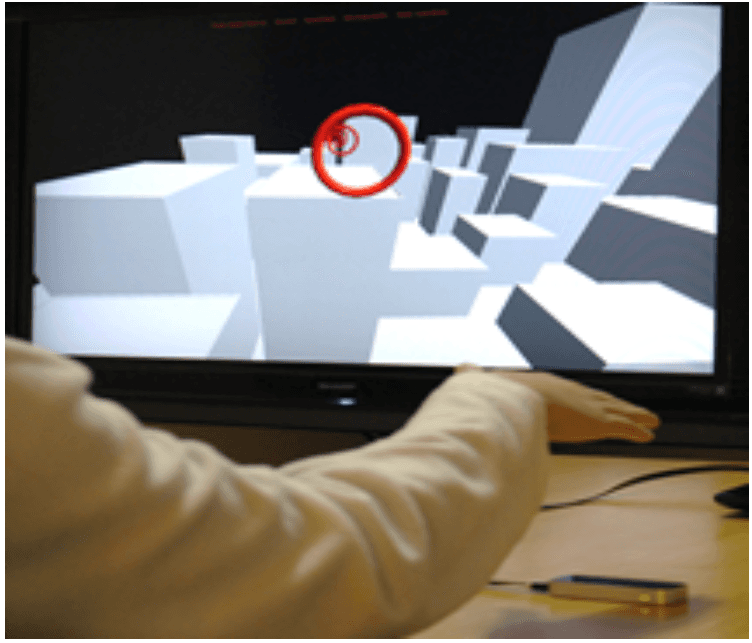
Identify design principles for effective bare-hand travel techniques using the Leap Motion Controller across different types of 3D navigation tasks.
Challenge
Bare-hand devices like the Leap have a limited tracking workspace (~3–50cm) and lose accuracy beyond ~80° hand rotation — making it unclear how to design reliable travel techniques around these constraints
No established design guidance existed for this new class of input devices
Approach
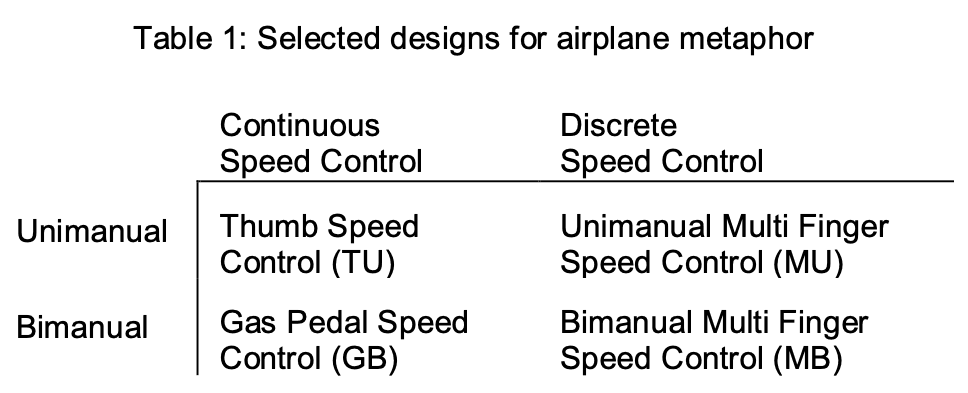
Designed and prototyped 5 travel techniques spanning 2 metaphors (airplane, camera-in-hand), 2 control types (rate vs. position), and 2 handedness modes (unimanual vs. bimanual)
Evaluated with 12 participants across 3 task types: absolute travel, naïve search, and path following
Used ANOVA to measure technique effect on speed and accuracy per task
My Role
Lead researcher responsible for technique design, prototype implementation, study design, and analysis.
Key Findings
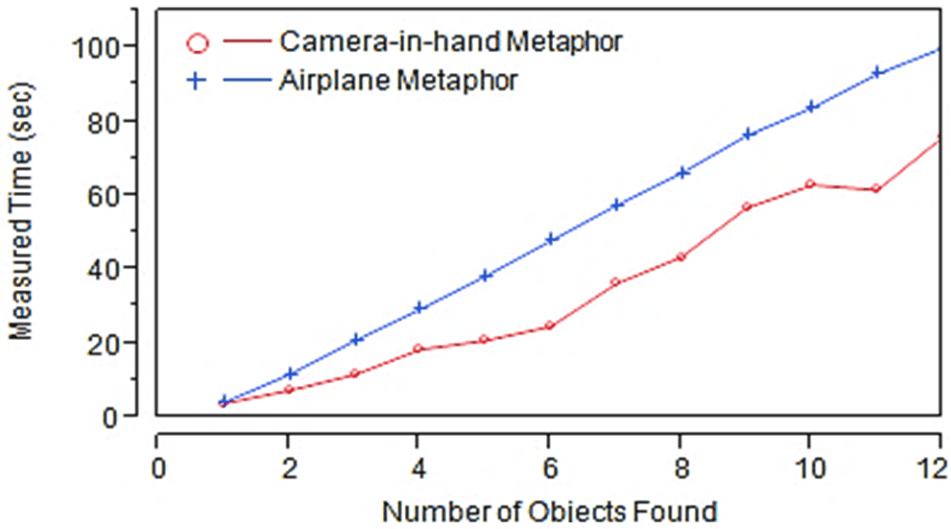
Camera-in-hand was significantly faster for search tasks — found all 12 targets faster than all 4 airplane techniques (p < 0.005)
Airplane metaphor was significantly more accurate for path following (p < 0.0001) — better suited where precise trajectory control matters
Bimanual techniques required more learning time — efficiency gap vs. unimanual narrowed only in the second half of tasks
Continuous speed control (finger-based) outperformed discrete methods and provided a better user experience overall
Key insight: no single technique wins across tasks — technique choice must match the navigation goal